You Won’t Believe These Hidden Architectural Gems in Punta del Este
Punta del Este is famous for its glamorous beaches and luxury lifestyle, but few know about its stunning, off-the-beaten-path architecture. I stumbled upon these unique structures by accident—and was completely blown away. From surreal sculptures to modernist homes tucked in nature, this side of Uruguay is a visual feast. If you’re tired of tourist traps, come with me to discover a different kind of beauty—one that’s quiet, bold, and totally unexpected. These hidden gems don’t appear on every postcard, but they reveal a deeper layer of creativity, history, and harmony with the landscape. This is not just a journey through place, but through perspective.
Beyond the Glamour: A Different Side of Punta del Este
Punta del Este has long been celebrated as South America’s Riviera—a playground for the affluent, dotted with high-rise condos, designer boutiques, and sun-drenched marinas. Its reputation for elegance and exclusivity draws visitors from across the continent and beyond, especially during the Southern Hemisphere’s summer months when the coastline pulses with energy. Yet beneath this polished surface lies a quieter, more contemplative dimension: one shaped by bold architectural visions and artistic experimentation. These are not the flashy landmarks that dominate travel brochures, but subtle masterpieces embedded in the natural contours of cliffs, forests, and secluded shores.
What makes these hidden structures so compelling is their ability to merge with the environment rather than dominate it. While many travelers flock to the bustling Playa Brava or snap photos at the iconic La Mano sculpture, few venture just a bit further to witness how architecture in this region can be both innovative and deeply respectful of its surroundings. These works reflect a philosophy where form follows function, yes—but also where design serves as a dialogue between human imagination and the raw power of nature. Exploring them transforms a typical beach holiday into a cultural pilgrimage, offering insight into Uruguay’s understated yet profound artistic legacy.
For families, couples, and solo travelers alike, especially those seeking meaningful experiences beyond shopping and sunbathing, this architectural trail offers a refreshing alternative. It invites slower travel, where observation replaces haste and curiosity replaces routine. You don’t need an architecture degree to appreciate these spaces—only an open mind and a willingness to wander slightly off the beaten path. The reward is not just visual delight, but a deeper sense of connection to a place that reveals itself gradually, like light filtering through concrete louvers at dawn.
The Icon You Know — And the Ones You Don’t
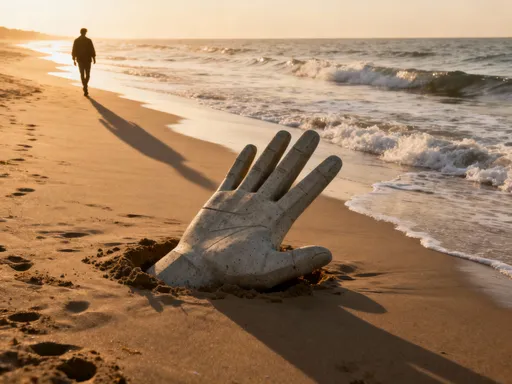
No visit to Punta del Este feels complete without seeing La Mano, the towering sculpture of five fingers emerging from the sand on Playa Brava. Created by Chilean artist Mario Irarrázabal, it’s a powerful symbol of human vulnerability and isolation, often interpreted as a cry rising from the ocean itself. Millions have photographed it, yet most leave without realizing that similar artistic expressions lie just beyond view—equally moving, yet far less crowded. Along quieter stretches of coastline, particularly near Punta Ballena and the rocky inlets south of Gorriti Island, other sculptural interventions wait in stillness, revealed only to those who walk slowly and look closely.
One such discovery is the series of submerged hand casts embedded along tidal zones, visible only at low tide. These ghostly impressions, made from weather-resistant concrete, echo the gesture of La Mano but feel more intimate, as if left behind by unseen visitors from another time. The contrast between the famous sculpture’s prominence and these hidden counterparts’ humility creates a compelling narrative about visibility and memory. Unlike the crowded selfie spot on Playa Brava, these lesser-known works encourage reflection. Standing beside them, you might feel the cool mist off the Atlantic, hear the distant cry of gulls, and sense a rare kind of solitude—even within a popular resort region.
Other abstract installations dot the coastal trails, often blending seamlessly into the terrain. Some resemble fractured monoliths; others take the form of curved walls that frame the horizon like living picture frames. Their materials—concrete, steel, and weathered stone—age gracefully, shaped by salt, wind, and sun. What unites them is a shared intention: to provoke thought, not just admiration. The interplay of light and shadow across their surfaces changes dramatically throughout the day, transforming the experience of each piece. At sunrise, long golden beams stretch across textured facades; at dusk, the same structures cast deep, geometric shadows that ripple across the sand. These are not static objects, but dynamic participants in the rhythm of nature.
Modernist Homes Meets Nature: The Architecture of José Antonio Errázuriz
If any architect embodies the soul of Punta del Este’s hidden design culture, it is José Antonio Errázuriz, a visionary Uruguayan modernist whose work redefined the relationship between buildings and landscape. Active primarily in the mid-to-late 20th century, Errázuriz rejected the notion that luxury meant opulence. Instead, he championed clean lines, natural materials, and a deep respect for topography. His homes, often perched on rocky outcrops or nestled within eucalyptus groves, don’t sit on the land—they become part of it. Walls of glass dissolve boundaries between interior and exterior, while cantilevered roofs provide shelter without blocking views of the endless horizon.
Some of his most celebrated works can be found in the hills of Punta Ballena and along the Sierra de las Ánimas, a scenic ridge that offers panoramic vistas of the Atlantic and Río de la Plata. These homes feature exposed concrete beams, wooden paneling, and asymmetrical layouts that respond to the slope of the terrain. Large overhangs protect interiors from harsh sunlight, while strategically placed courtyards allow breezes to flow naturally through living spaces—passive design principles that remain relevant today. What strikes visitors most is how these homes feel lived-in and warm despite their minimalist aesthetic. They are not cold monuments to style, but thoughtful responses to climate, light, and human comfort.
While many of Errázuriz’s residences remain privately owned, several can be viewed from public walking trails or during guided eco-architecture tours offered by local cultural organizations. These tours, often led by architects or preservationists, provide context about construction techniques, material sourcing, and the architect’s philosophy. Some homes even incorporate native stone collected from the surrounding area, reinforcing the idea of local harmony. For travelers interested in sustainable design, these structures offer timeless lessons: beauty need not come at the expense of the environment, and true luxury lies in simplicity, space, and serenity.
Concrete Dreams: Brutalism with a Beachside Twist
At first glance, the idea of Brutalist architecture on a sun-soaked coastline might seem contradictory. Known for its massive scale, raw concrete surfaces, and imposing geometries, Brutalism is often associated with urban civic centers or university campuses in Europe and North America. Yet in and around Punta del Este, this bold style found an unexpected home—one where its rugged textures and sculptural forms complement rather than clash with the natural setting. These buildings, though understated in number, stand as testaments to a mid-century moment when Uruguayan designers embraced modernism with confidence and originality.
Examples include small cultural pavilions tucked into forested areas, private villas with fortress-like exteriors that open into light-filled interiors, and remnants of old seaside clubs built during Uruguay’s architectural renaissance in the 1960s and 70s. One notable structure near La Barra features a series of interlocking concrete cubes, each slightly offset to create shaded terraces and private courtyards. From a distance, it resembles a geological formation; up close, its textured walls reveal the imprint of wooden forms used during pouring—a signature of artisanal craftsmanship. The contrast between the soft dunes and the hard, angular lines of these buildings creates a visual tension that is both striking and harmonious.
This regional interpretation of Brutalism differs from its colder, more utilitarian counterparts elsewhere. Here, the style was adapted to prioritize comfort, privacy, and integration with nature. Roofs are often green or sloped to blend with the hillside; windows are narrow to reduce glare but positioned to capture ocean breezes and sunset views. These buildings were never meant to dominate the landscape—they were designed to endure it. Over decades, they’ve developed a patina of lichen and moss, further softening their appearance and allowing them to age with dignity.
For respectful travelers, observing these sites requires mindfulness. Many are on private property, so trespassing is discouraged. However, several can be appreciated from designated paths or during organized architectural walks. Photography is welcomed, especially during the golden hours when sunlight highlights the depth and texture of the concrete. These structures remind us that beauty can emerge from strength, and that even the most solid forms can feel poetic when placed in the right context.
Art Installations That Double as Architecture
In the rural outskirts of Punta del Este, where farmland meets coastline, a fascinating category of structures blurs the line between sculpture and shelter. These are not merely decorative—they are spatial experiences, large enough to walk into, stand beneath, or move around in a way that alters perception. Among the most evocative is El Cubo de la Vida (The Cube of Life), a hollow concrete cube standing alone in a windswept field. Its walls are precisely cut, with openings aligned to frame specific views of the sky, horizon, or distant hills. Inside, the space feels simultaneously enclosed and infinite, a meditation on containment and freedom.
Other installations take the form of spiraling ramps, arched tunnels, or elevated platforms that invite visitors to engage physically with the artwork. Some are the work of Uruguayan artists influenced by land art movements of the 1970s, while others were commissioned more recently as part of public art initiatives. What unites them is a commitment to experiential design—art that is not just seen, but felt. Walking through a curved concrete corridor as the wind hums through narrow slits, or standing beneath a floating roof supported by a single column, creates a sense of wonder that transcends language.
These spaces are particularly meaningful for mindful travelers—those seeking stillness, reflection, or a break from the sensory overload of city life. Families with older children often find them intriguing, as they encourage exploration and imaginative play. Unlike traditional museums or galleries, there are no ropes, no guards, and no entry fees. The experience is self-guided, intimate, and free. Yet there’s an unspoken rule: these works are fragile not in structure, but in spirit. They rely on quiet appreciation, not spectacle. Visitors who approach them with reverence often leave with a renewed sense of awe for how simple forms can evoke deep emotion.
How to Find These Hidden Spots: A Practical Guide
Discovering Punta del Este’s architectural treasures requires a shift in mindset—from passive sightseeing to active exploration. The good news is that many of these sites are accessible with minimal effort, especially if you plan strategically. The best time to visit is during the shoulder seasons—March to May and September to November—when temperatures are mild, crowds are thinner, and natural light is ideal for photography. Early mornings and late afternoons offer the most dramatic lighting, with long shadows and warm hues enhancing the textures of concrete and stone.
A rental car provides the most flexibility, allowing you to set your own pace and access remote trails. Major agencies operate at Carrasco International Airport in Montevideo and locally in Punta del Este. Alternatively, several tour operators offer specialized eco-architecture excursions that combine guided commentary with stops at key sites. These are especially valuable for first-time visitors, as local guides know the exact locations of lesser-known installations and can share stories about their creation and cultural significance.
While digital maps are helpful, they don’t always mark these hidden spots accurately. Consider downloading offline maps or using GPS coordinates shared by cultural tourism groups. Some locations, like certain Errázuriz homes or remote sculptures, are best reached via marked hiking trails in protected natural areas. Wear comfortable walking shoes, bring water, and pack a light jacket—the coastal wind can be brisk even on sunny days.
Responsible tourism is essential. These structures, whether public art or private homes, are part of Uruguay’s cultural heritage. Avoid climbing on sculptures, leaving trash, or marking surfaces in any way. Respect signage indicating private property or restricted access. Remember, the goal is not just to see these places, but to preserve them for future generations. Bring a camera, but also bring patience—some of the most powerful moments happen when you simply sit quietly and let the space speak to you.
Why This Side of Travel Matters
In an age of instant gratification and curated social media feeds, traveling with intention has never been more important. Seeking out Punta del Este’s hidden architectural gems is not just about finding photo-worthy backdrops—it’s about cultivating a deeper relationship with a place. These structures, shaped by visionaries who respected both art and environment, remind us that beauty often lies in the details, in the quiet corners, in the spaces between the noise. They challenge the notion that travel must be fast, loud, or extravagant to be meaningful.
Slow exploration fosters mindfulness. When you take the time to study how a wall meets the sky, or how light moves across a concrete floor over the course of an hour, you begin to see the world differently. You notice craftsmanship. You appreciate silence. You connect with history not through plaques, but through presence. For mothers, caregivers, and women who often prioritize others’ needs over their own, this kind of journey offers a rare gift: the chance to pause, reflect, and rediscover curiosity.
Moreover, supporting cultural and architectural tourism helps sustain local preservation efforts. When visitors show interest in lesser-known sites, communities are more likely to protect them. Local guides, artisans, and conservation groups benefit directly from this form of travel, creating a positive ripple effect. By choosing to explore beyond the obvious, you contribute to a more balanced, respectful, and enriching tourism economy—one that values depth over dazzle.
So the next time you plan a getaway to Punta del Este, look beyond the yachts and boutiques. Let your itinerary include a morning walk along a quiet shore, a visit to a modernist home nestled in the hills, or a moment of stillness inside a concrete cube beneath an open sky. In the silence between the waves and the concrete, you’ll find the soul of Punta del Este—not in its glamour, but in its quiet courage to be bold, thoughtful, and true.