You Won’t Believe These Arches National Park Viewpoints
Standing beneath a fiery red sky as the sun dips behind endless sandstone fins, I realized Arches National Park isn’t just a destination—it’s a feeling. With over 2,000 natural stone arches carved by time, this Utah wonderland offers some of the most breathtaking viewpoints in the American Southwest. From iconic landmarks to hidden overlooks, every turn reveals a new masterpiece shaped by wind and water. This is nature at its most dramatic—and it’s waiting for you.
Why Arches National Park Stands Out Among U.S. National Parks
Located just outside the small desert town of Moab in eastern Utah, Arches National Park occupies a unique place in America’s network of protected landscapes. Spanning over 76,000 acres, the park sits atop a vast underground salt bed that has shaped its surreal terrain over millions of years. As tectonic forces uplifted the region, the salt layer shifted and cracked the overlying rock, creating deep fissures and fins that erosion gradually sculpted into free-standing arches. This ongoing geological dance has produced more than 2,000 documented natural stone arches—more than any other location on Earth—making Arches a global epicenter for this rare geological phenomenon.
What truly distinguishes Arches from other desert parks is the density and accessibility of its iconic formations. While nearby Canyonlands National Park offers vast canyons and river systems, and Capitol Reef showcases layered monoclines, Arches delivers an intimate experience with nature’s stonework. Visitors don’t merely gaze at distant horizons—they walk beneath arches, stand beside towering balanced rocks, and witness sunlight filter through sandstone windows in vivid hues of amber, rust, and gold. The park’s compact layout allows travelers to experience multiple world-class viewpoints in a single day, all connected by a well-maintained scenic drive.
Equally important is the sensory immersion the park provides. The silence is profound, broken only by the whisper of wind through rock corridors or the crunch of sandstone underfoot. The air carries a clean, mineral scent, and the warmth of the sun radiates from the stone long after sunset. These subtle details transform a simple visit into a deeply personal encounter with the ancient Earth. For many, especially those raising families or seeking moments of reflection, Arches offers a rare blend of awe and tranquility that few other national parks can match. It’s not just about checking off landmarks—it’s about feeling connected to something timeless.
Delicate Arch: More Than Just an Icon
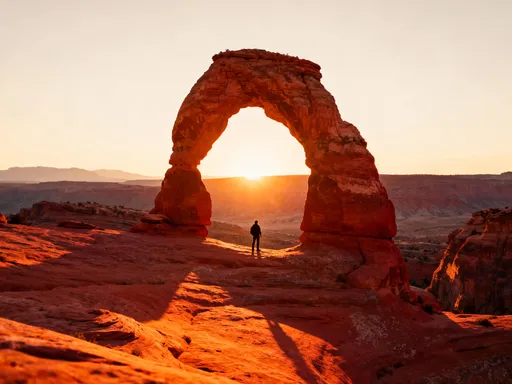
No single formation defines Arches National Park quite like Delicate Arch. Standing alone on a curved sandstone fin, this 65-foot-tall freestanding arch has become the symbolic heart of the park and one of the most photographed natural features in the American West. Its elegant curve, framed against the vastness of the La Sal Mountains in the distance, evokes a sense of balance and permanence, even as it reminds visitors of nature’s fragility. The arch appears on Utah’s license plate, graces countless postcards, and draws thousands of hikers each year—all eager to stand beneath its graceful span.
The journey to Delicate Arch is as meaningful as the destination. The 3-mile round-trip trail begins at the Wolfe Ranch parking area and climbs steadily across sun-exposed terrain with minimal shade. Hikers navigate rocky slabs, metal handrails, and a final ledge with a slight exposure—nothing dangerous for most, but enough to quicken the pulse. The path rewards persistence with ever-expanding views: first of the surrounding basin, then of the arch itself emerging gradually from behind the rock wall. When hikers finally step onto the viewing platform, the full grandeur of Delicate Arch unfolds in a moment that many describe as spiritual.
Timing is essential for an optimal experience. Midday visits bring intense heat and large crowds, particularly in spring and fall. For the best light and solitude, sunrise and sunset are ideal. At dawn, the arch glows with a soft pink hue as the sun rises behind it. At dusk, it stands in silhouette against a fiery sky, creating one of the most dramatic photographic opportunities in any national park. Early risers or late stayers often find themselves sharing the space with only a few fellow travelers, enhancing the sense of intimacy. Families with older children may prefer the late afternoon start, arriving just before sunset to witness the transformation of light without the challenge of a dark return hike.
Balanced Rock: Where Geology Meets Wonder
One of the most accessible and family-friendly stops in the park, Balanced Rock offers a powerful example of nature’s artistry without requiring a strenuous hike. Located just off the main park road, this 136-foot-tall formation consists of a massive boulder perched precariously atop a narrow sandstone pedestal. Weighing an estimated 3,600 tons, the capstone appears to defy gravity, yet it has remained in place for thousands of years. The contrast between the dark, erosion-resistant boulder and the softer, rust-colored base illustrates the selective nature of weathering processes in desert environments.
A paved, wheelchair-accessible trail of just 0.3 miles loops around the base of Balanced Rock, offering multiple vantage points for photos and quiet observation. Interpretive signs along the path explain how differential erosion—where harder rock layers resist breakdown while softer layers beneath wear away—created this striking formation. For children and adults alike, it serves as a tangible lesson in geology, sparking curiosity about how such wonders form and how long they may endure. Park rangers often cite Balanced Rock as a favorite educational stop, especially for school groups and young families seeking an engaging yet low-effort experience.
Sunrise is an especially magical time to visit. As the first rays of light strike the eastern face of the rock, the colors shift from deep shadow to warm amber, highlighting the texture and scale of the formation. The surrounding landscape, dotted with juniper and sagebrush, emerges slowly from the morning haze, creating a serene atmosphere perfect for reflection. Because the site is easily reachable, it also tends to attract early photographers and quiet seekers before the midday crowds arrive. Visitors can combine this stop with nearby picnic areas or extend their morning by continuing to the Garden of Eden viewpoint, where panoramic views of the surrounding fins and mesas set the stage for the rest of the day’s exploration.
The Windows Section: A Gateway to Grandeur
For many first-time visitors, the Windows Section offers the most immediate and awe-inspiring introduction to the park’s arch-filled landscape. Clustered within a short walking distance, North Window, South Window, and Turret Arch form a natural amphitheater of sandstone masterpieces. The large, circular openings of the two main windows frame distant mesas and the La Sal Mountains beyond, creating picture-perfect compositions that require little effort to capture. Turret Arch, slightly set apart, offers a more intimate passage and a favorite spot for children to scramble through and explore.
The trail system here is well-developed and largely flat, making it ideal for families, older adults, and those with limited mobility. A paved path leads from the parking area to the main viewing area, with additional dirt paths branching off to offer different angles. The full loop, including all three arches, covers about 1 mile and can be completed in under an hour. Despite its ease, the visual payoff is extraordinary. Standing between North and South Window, visitors can look through both arches simultaneously—a rare alignment that photographers cherish. The interplay of light and shadow changes throughout the day, with mid-morning and late afternoon offering the most balanced illumination.
Because of its accessibility and iconic scenery, the Windows Section is among the busiest areas in the park. To avoid congestion, arriving early in the morning or later in the afternoon is recommended. These times also provide softer light for photography, reducing harsh contrasts and glare. For a more immersive experience, some visitors choose to sit quietly on the sandstone benches near South Window, listening to the wind and watching lizards dart between crevices. The sense of scale—of standing beneath arches that have endured for millennia—often prompts quiet contemplation. It’s a place where families pause, couples hold hands, and solo travelers feel a deep connection to the land.
Devils Garden: Adventure Meets Panoramic Vistas
Nestled in the northern reaches of the park, Devils Garden represents the wilder, more adventurous side of Arches. This area features a network of trails that range from easy walks to challenging backcountry routes, catering to hikers of all experience levels. The main trailhead offers access to several key formations, including Landscape Arch—one of the longest natural stone spans in the world, measuring 290 feet from base to base. Its slender, ribbon-like structure appears almost too delicate to endure, yet it has withstood centuries of wind and temperature fluctuations.
The Devils Garden Trail begins as a well-maintained path but soon splits into multiple options. The Primitive Loop, a 3-mile circuit, ventures off established ground, requiring hikers to navigate rock cairns and uneven terrain. Along the way, visitors encounter a series of smaller arches—Pine Tree Arch, Tunnel Arch, and Partition Arch—each tucked into secluded alcoves. These hidden gems reward those willing to step off the beaten path with solitude and unexpected beauty. The trail also passes through a surreal landscape of fractured fins and narrow passageways, where sunlight filters in dramatic shafts, creating an almost cathedral-like atmosphere.
For those seeking a greater challenge, the 7.2-mile out-and-back trek to Dark Angel—a striking 150-foot sandstone spire—offers panoramic desert views and a sense of true remoteness. While the hike is strenuous, especially in summer heat, it provides a deeper understanding of the park’s geological complexity. Proper preparation is essential: sturdy footwear, ample water, sun protection, and a detailed map are non-negotiable. The National Park Service recommends carrying at least one gallon of water per person for any hike longer than two miles. Because cell service is nonexistent, relying on the official NPS app for offline maps and safety information is strongly advised.
Panorama Point & La Sal Mountains Overlook: Under-the-Radar Gems
While many visitors focus on the park’s named arches, some of the most emotionally resonant experiences come from its overlooks. Panorama Point and the La Sal Mountains Overlook, both located along the scenic drive, offer sweeping vistas that capture the vastness of the Colorado Plateau. From these elevated vantage points, the desert unfolds in layers—red rock formations, distant canyons, and the snow-capped peaks of the La Sal Mountains rising over 12,000 feet in the distance. The contrast between the arid landscape below and the alpine heights beyond is nothing short of breathtaking.
Panorama Point, accessible via a short paved path, provides a 360-degree view of the park’s central and northern regions. On clear days, visibility extends for miles, allowing visitors to trace the path of the Colorado River and identify major landmarks like Courthouse Towers and the Fiery Furnace. The site is especially popular at sunset, when the entire horizon glows in shades of crimson and gold. Because it’s less crowded than Delicate Arch or the Windows, it offers a peaceful space for reflection, journaling, or quiet conversation.
The La Sal Mountains Overlook, located a few miles further, focuses on the eastern skyline. Here, the mountains stand in sharp relief against the desert floor, their peaks often dusted with snow well into spring. The overlook is fully accessible and includes interpretive panels that explain the geology of the range and its role in shaping the local climate. Morning visits are ideal for photography, as the rising sun illuminates the snowfields while the valley remains in soft shadow. These overlooks may not feature arches, but they provide essential context—reminding visitors that Arches is not just a collection of rock formations, but part of a much larger, interconnected ecosystem.
Practical Tips for Maximizing Your Viewpoint Experience
Planning a visit to Arches National Park requires more than just choosing which arches to see—it demands thoughtful preparation. The park operates under a timed entry reservation system from April through October, meaning visitors must secure a reservation in advance through the National Park Service website. Without a reservation during peak hours, entry is not guaranteed, even for those staying nearby in Moab. Reservations open months in advance and fill quickly, especially for weekends and holidays, so early planning is crucial.
Weather plays a significant role in the quality of the experience. Summer temperatures frequently exceed 100°F (38°C), making midday hikes dangerous without proper hydration and sun protection. The best times to explore are early morning and late afternoon, when temperatures are cooler and wildlife is more active. Spring and fall offer the most favorable conditions, with mild days and crisp nights. Winter visits are less crowded and provide unique photo opportunities with snow-dusted arches, though some trails may be icy and parking areas limited.
All visitors should carry at least one gallon of water per person per day, wear sturdy footwear, and apply sunscreen regularly. Staying on designated trails is essential to protect the fragile cryptobiotic soil—a living crust of algae, fungi, and bacteria that stabilizes the desert floor and supports plant life. Damaging this soil can take decades to repair. The NPS app provides real-time updates on trail conditions, closures, and shuttle services, and downloading maps for offline use ensures navigation even without signal. Finally, practicing Leave No Trace principles—packing out all trash, respecting wildlife, and keeping noise levels low—helps preserve the park’s beauty for future generations.
Conclusion: Why These Viewpoints Stay With You Long After You Leave
The true magic of Arches National Park lies not just in what you see, but in how it makes you feel. Standing beneath Delicate Arch at sunset, watching light pour through North Window, or gazing at the La Sal Mountains from a quiet overlook—these moments imprint themselves on the soul. They remind us of the Earth’s quiet power, its patience, and its ability to create beauty through time and erosion. For mothers, daughters, sisters, and friends who seek connection—to nature, to family, to themselves—Arches offers a sanctuary where the noise of daily life fades and the essentials come into focus.
Each viewpoint tells a story—not just of geology, but of resilience, balance, and transformation. The arches will not last forever; some have already collapsed, and others will follow. This impermanence makes the experience even more poignant. To witness them is to participate in a fleeting moment of natural history. And in that awareness, there is a call to stewardship. By visiting mindfully, respecting park guidelines, and teaching children to tread lightly, we help ensure that these wonders endure.
Arches National Park does not shout. It whispers. It asks only that we slow down, look closely, and listen. In return, it offers perspective, peace, and a renewed sense of wonder. Whether you come for the photos, the hikes, or the quiet moments in between, one truth remains: you won’t believe these viewpoints—until you stand in them yourself.